Hayes Dress and Set Fitting and Custom Adjustments
Looking for assistance fitting the Hayes? You've come to the right place! We have put this post together to cover the most common fitting adjustments you may need for the Hayes sewing pattern. Find fitting posts for each of our patterns in the fitting and custom adjustments library here.


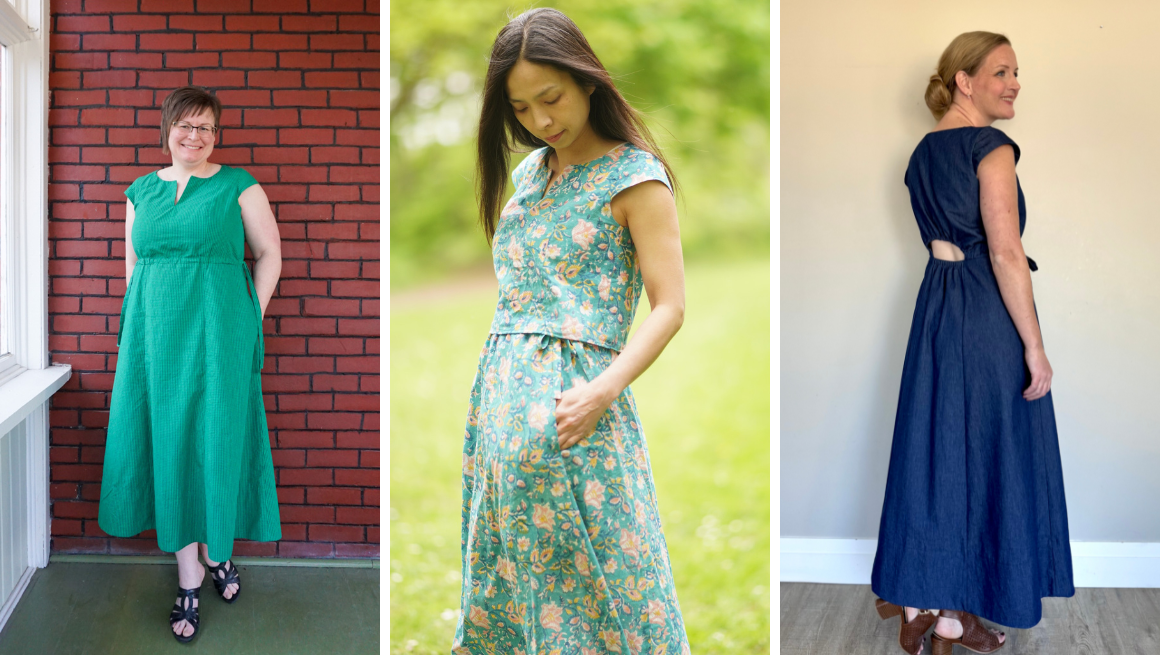
You can check out our Tester Inspiration post here if you're interested in seeing it on a variety of body types. During testing, we work through the fit for each tester, which helps inform what fitting and custom adjustments we talk about in our fitting posts. Most of these adjustments are included in the pattern tutorials and, if more fit questions come up, we will continue to add them to the blog post.

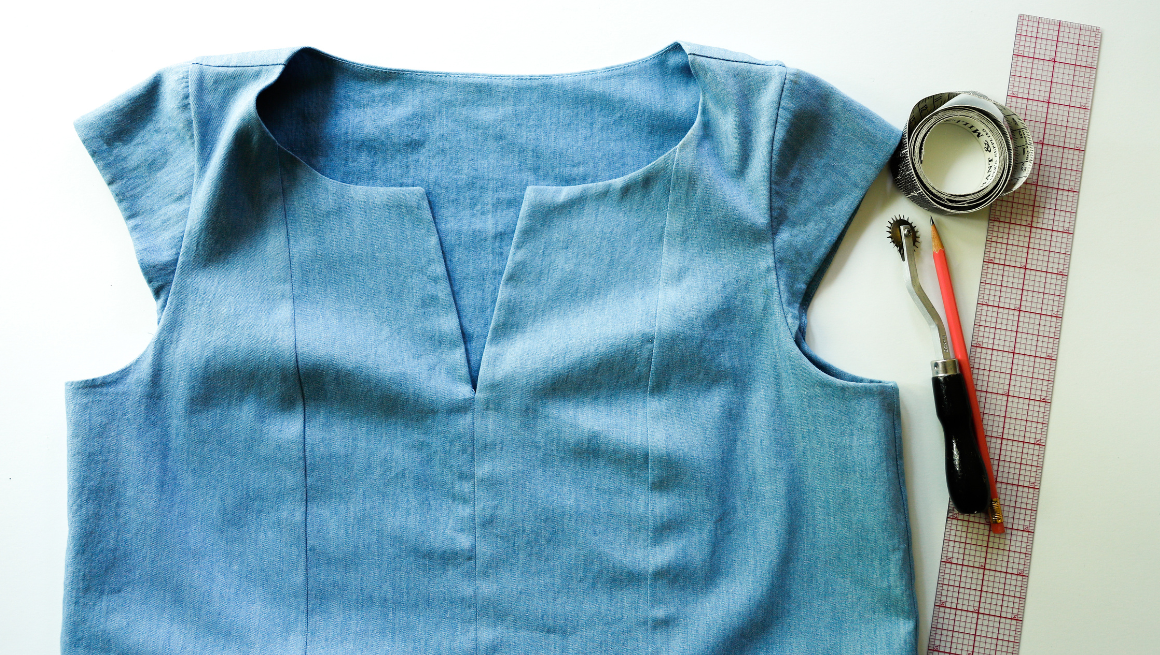
The Hayes is a woven dress or two-piece set in a maxi length. The bodice features cap sleeves and a front neckline slit. The paneled skirt is an A-line shape with inseam pockets. The dress includes two back options, an open cutout and full coverage. The waistline is adjustable with drawstrings that tie at the side seams. The waistline is designed to sit high at the natural waist. When sewing the set, the top is a cropped length.


Before we get started, I always like to add a note that the goal should be to create a comfortable garment that you will enjoy wearing. I don't think it's important to get rid of every single drag line and pull, so be kind to yourself as you are analyzing your fit. If you have specific questions about fitting the Ivie, you can always reach out in our Chalk and Notch Facebook Group or email us here.

HOW TO PICK A SIZE
First, make sure you take new measurements before starting any project because our bodies change, and starting with accurate numbers is the first step to getting a good fit. You will need the following measurements:
High Bust - Measure around your body, above your bust, just under your arms. Make sure your tape is level around your body. Rest your arms at your sides when measuring.
Full Bust - Measure around your body, at the fullest part of your bust. Make sure your tape is level around your body. Rest your arms at your sides when measuring.
Waist - Measure around your body, at the smallest part of your torso. If you are having trouble finding your waist, lean over to one side, your waist is where your body bends.
Hips - Measure around your body, at the fullest part of your hips/bum.
A few other measurements will be helpful. Cross-check these with the finished garment measurement chart to see if you need any custom adjustments.
Top Center Back (CB) to Hem - Measure from the base of your neck to where you want the top to finish.
Skirt Length - Measure from the waist to where you want your skirt/dress to finish. The finished length of the skirt is a maxi and ends above the ankle. Review the finished garment measurements to determine if you would like to adjust the length.
BODY MEASUREMENTS
Use the high bust and full bust measurements to determine your size when sewing the dress or top. Use the hip measurement to determine your size when sewing the skirt. The waist is adjustable based on the drawstrings. It is always recommended to sew a test garment to confirm fit.
This pattern includes two bust cup options and the cup size is determined by calculating the difference between the high and full bust. If the difference between your high bust and full bust is between 0" and 2" (5 cm) use the A/B cup. If the difference is between 2" (5 cm) and 4" (10 cm) use the C/D cup. If you have more than a 4" (10 cm) difference, you may need a full bust adjustment.

FINISHED GARMENT MEASUREMENTS
Pick the size for each of the measurements that work best for your body and preferred fit.

REVIEW THE INTENDED EASE & FINISHED LENGTH
BUST - Hayes is designed with is 4" (10 cm) of ease through the bust for the open back view and 3" (7.5 cm) for the full back view. If you are between sizes in the bust, I suggest sizing up.
WAIST - Without elastic, there is 10” (25.5 cm) of ease through the waist. If your waist falls in a larger size, you can adjust the length of the elastic without blending sizes if the finished measurement includes enough ease. Review the waist measurement without elastic in the chart above.
HIPS - There are 11” (28 cm) of ease through the hips.
FINISHED LENGTH - The finished length of the dress bodice ends high at the natural waist. The finished length of the dress and skirt is a maxi and ends at the ankle. The top is cropped and 1 1/2" (4cm) longer than the dress bodice. The finished center back measurements are listed in the chart above. Review to see if you'd like to add length.
MAKING A MUSLIN
I will always advise you to make a muslin or toile (test garment) before cutting into your final fashion fabric. If you'd like more info on fabrics, we have a recommended fabric post for the Hayes here.

CUSTOM ADJUSTMENTS
There are often many ways to make the same adjustments, and a simple adjustment can affect many areas. The following are the most common adjustments we saw during testing.
LENGTHEN/SHORTEN BODICE
The dress waist finishes high at the natural waist. The top is cropped. If you decide you'd like to add or remove length through the torso, adjust at the lengthen/shorten line.
- Select the center front, side front, and back bodice pattern pieces.
- Cut the pattern pieces horizontally at the indicated line. Add or remove length.
- Re-draw the side seams.

LENGTHEN/SHORTEN SKIRT
The skirt/dress is designed to finish as a Maxi and ends above the ankle. If you decide you would like to add or remove length in the skirt, adjust at the lengthen/shorten line.
- Select the center front skirt, side front skirt, side back skirt and center back skirt pattern pieces.
- Cut the pattern horizontally at the indicated line. Add or remove length.
- Re-draw the seams.
- Double check that your hem facing pattern piece still matches the hem.

FULL BUST ADJUSTMENT
f you have over 4” (10 cm) between your high bust and full bust, you may need a Full Bust Adjustment to the D cup bodice. You will still need to make a bodice muslin/test garment to confirm fit.
- First decide how much more ease you need through your bust. You will add half that amount to your pattern. If you need 2” (5 cm), then you will add 1” (2.5 cm).
- You want to split the amount and add 3/4 of the amount to the side bust and 1/4 of the amount to the center front at the bust point.
-
Draw a new curve. Blend to zero at the neckline and at the hem.

-
Now you will need to add length back to the center front pattern piece. Measure the side bust and center front at the sew line. Cut the center front and add any necessary length.

-
Once the seam length and notches match, you have completed the FBA.

ADJUSTING THE SHOULDER
If your shoulder seam does not follow the slope of your body and your armhole is gapping near the shoulder, you may want to adjust the shoulder angle. This adjustment can be made on the front and back pattern pieces, or just one, depending on where you need the adjustment.
- Simply pinch out the gap.
- Transfer that amount to the pattern and adjust. In this example, we are making a more angled slope on the front and back pattern pieces.
- Double check that your shoulder seams are still the same length.

ADJUSTING THE ARMHOLE
If your armhole is too low or too high, you can adjust the lower curve of the armhole.
- Simply mark how much you want to add or remove. In this example, we are lowering the armhole.
- Redraw the underarm curve to the notch.
- There is no need to adjust the sleeve for this adjustment.

Hopefully, this has been helpful as you fit the Hayes pattern. It's totally worth the time to make a muslin, make any adjustments, and update your printed pattern. Remember to write down some notes for yourself so that when you come back to the pattern, you know what adjustments you have made. Please let me know if you have any other fit questions, and I can update the post as needed.
Happy Sewing!
XO, Gabriela